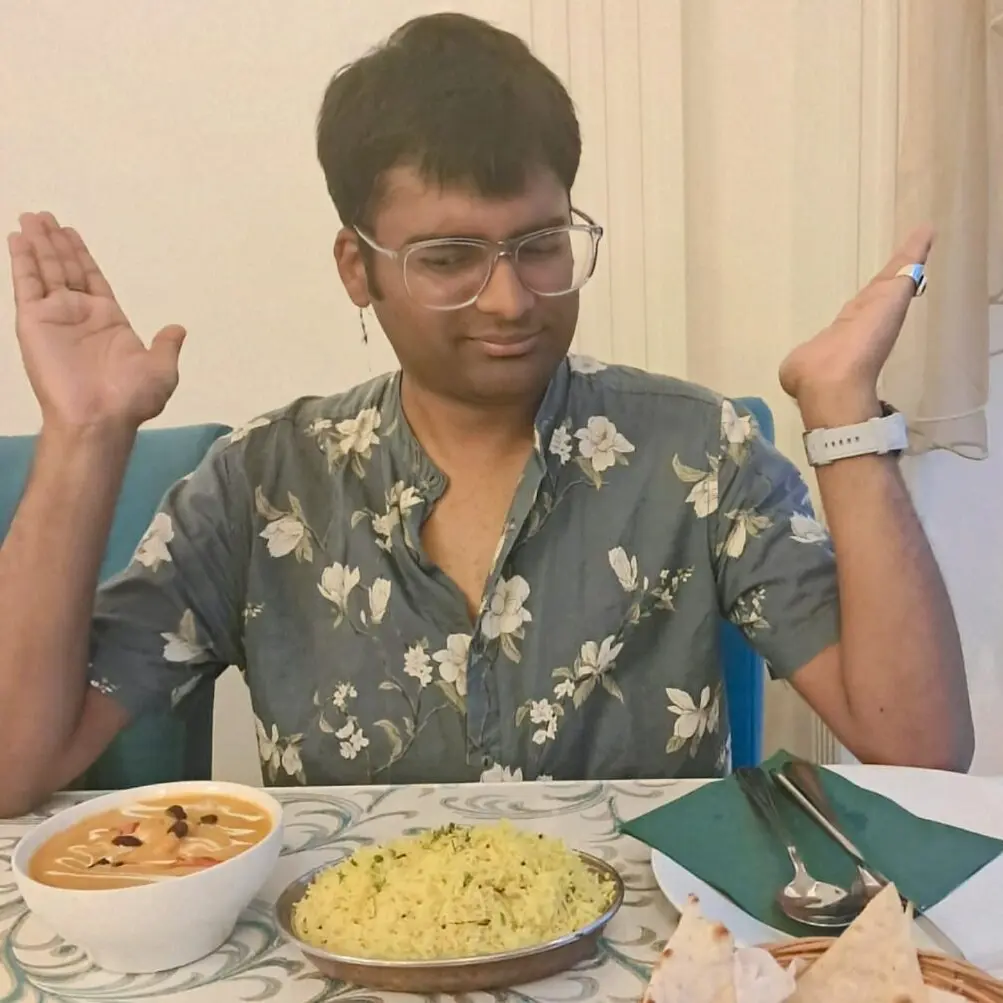
The Day I Was Denied Mango Chicken Curry With Lemon Rice
In this post, I share my experiences of exclusion and alienation being part of the Indian diaspora in the Czech Republic and how many Indian identities are not considered Indian enough by the mainstream cultural authorities.
Published: 8/30/2025
Food is never just food. What we eat, how we prepare it, and what dishes we pair together are never neutral (or APOLITICAL) choices. They are acts of belonging, cultural and collective memory, resistance, and survival. Food is basically edible identity. Which is why the day I was denied mango chicken curry with lemon rice in Prague, dismissed by a waiting staff, who insisted that they “don’t go together” aesthetically or taste-wise—remains etched in my mind as more than just an innocent “unasked” opinion.
I was at an Indian restaurant in Prague with one of my white European friends, when I ordered these two dishes and explained that they taste good together since both are from the South and I had often eaten them side by side at South Indian weddings. However, the waiting staff told us that they are “completely off” and don’t go together.
It was not a disagreement of taste. It was a denial of identity, legitimacy, and the politics of representation within the Indian diaspora. That denial showed me how Indian identity, especially abroad, is selectively represented by those who already dominate cultural narratives at home: primarily upper-caste, Hindi-speaking, North Indian Hindu men.
Their confidence in curating and presenting “India” to the rest of the world is so complete that it delegitimizes or erases the traditions, cuisines, languages, and experiences of others; South Indians, East Indians, Muslims, Dalits, women, and queer people.
In this post, I want to reflect on that moment with mango chicken curry and lemon rice as a way of thinking about how diasporic representation works. How does the diaspora construct “Indianness” abroad? Who gets to be the default, and who is marked as secondary, exceptional, or even “inauthentic”? And what happens to those of us whose identities do not align with the hegemonic narrative?
Diaspora as Expert: The Sudden Authority of the Migrant
One of the peculiar yet funny things about diaspora is how people from very distinct cultures in India suddenly become “experts” in cultures they have very little connection to back home. For example, a North Indian Hindu who has grown up speaking nothing but Hindi and English in New Delhi all their lives. Once abroad, this person often reimagines their repertoire and suddenly becomes conversant in Punjabi, has enough Bengali and Marathi phrases to pass as “multilingual,” and confidently represents themselves as speaking “many Indian languages.”
Yet, conspicuously, these same individuals rarely claim knowledge of South Indian Dravidian languages. Telugu, Tamil, Kannada, or Malayalam rarely appear in their performance of linguistic diversity. Despite this, they emerge as experts on South Indian cuisine—rattling off the predictable list: Idli, Dosa, Sambar, Chutney. PERIOD. Sometimes, for extra exoticism, they might add “Madras Chicken” or a coconut milk-based dish on a restaurant menu. But even these dishes are flattened into the universal tag of “curry.”
The word “curry” itself is a problematic colonial inheritance. It homogenizes radically distinct foods under a single umbrella, stripping away cultural specificity and collapsing identities. A dish of Sambhar from Tamil Nadu, a Bengali Fish Jhol, and a Kashmiri Yakhni are all lumped together as “curry”, as though they are variations of one essential category, rather than profoundly different cuisines tied to land, climate, ritual, and history. I will leave the “politics of curry” terminology for another post. For now, it is enough to note how this flattening, both linguistic and culinary, sets the stage for how Indian identity is represented abroad.
Being Denied Mango Chicken Curry and Lemon Rice
Which brings me back to the mango chicken curry and lemon rice. When I ordered it, the person, who was from New Delhi (North Indian of course)—told me flatly that these two don’t “go together.” That they clash aesthetically. That they don’t make sense. But to me, they make perfect sense. To me, they are memory and nostalgia: the tang of lemon rice, the sweet-sour comfort of mango curry. The dismissal was about legitimacy and who gets to decide what combinations are valid, what dishes are representative, what foods count as authentically “Indian.”
This denial encapsulated the everyday injustices South Indians experience in India or even in the Indian diaspora spaces. South Indian food is exoticized, tokenized, and disciplined into categories that fit North Indian frameworks. The South Indian identities are marked as regional or exceptional, never as the mainstream or default. Moreover, both mango chicken curry and lemon rice are quintessentially South Indian cuisines.
That is why, when the person at the restaurant told me that I could eat them “differently if I was from the South” because “South Indians have different tastes sometimes,” the comment was directly a reinforcement of hierarchy. It screamed of a desire to establish that the mainstream palate is North Indian, and that legitimacy rests in their flavors, their combinations, their preferences. The unmistakable irony was that neither lemon rice nor mango chicken curry originates in the North. Neither is part of North Indian cuisine. If anything, the mainstream in this case is South Indian, and the North Indian opinion about what pairs or does not pair “properly” should NOT matter at all.
Selective Representation and Systemic Injustice
The larger pattern is clear that diasporic representation is selective. It privileges some identities while marginalizing others. It constructs a homogenized image of “Indian culture” that travels well abroad, but only because it is already anchored in dominant power structures back home. North Indian dominance is evident in the way Hindi-speaking, upper-caste Hindus present themselves as the natural representatives of India, with their food, festivals, and language treated as the default markers of Indian culture.
In contrast, South and East India are marginalized, often represented only through token dishes such as idli, dosa, or fish curry, or through decorative references that erase their cultural complexity. Kashmir too is appropriated, shown merely as an unquestioned and integral part of India while its independent culinary and cultural identity is erased. Muslim presence, despite being a significant part of Indian society, is made invisible in diaspora festivals and restaurants. Gendered simplifications are also clear and stark.
During my ethnographic fieldwork on the festivals of Indian diaspora in the Czech Republic, I made some interesting observations. For example, in one skit on the Marathi leader Lokmanya Tilak staged in Prague during Ganeshotsav, a woman spoke only after a man and never challenged anything, with 90% of her role reduced to nodding in agreement on stage. Alongside this, queer communities, such as the hijras and those with non-normative genders are written out of the diasporic script altogether, despite the fact that hijras have been an important and visible part of Indian community life for centuries. This further narrows the imagination of what counts as Indian identity.
Why This Matters
At one level, it may seem trivial: a restaurant menu in Prague, a festival performance, a plate of food. But representation matters because it shapes how communities see themselves and how they are seen by others. When diaspora spaces consistently erase or delegitimize certain identities, it reinforces the systemic injustices those communities already face back home. For South Indians, it means constantly being told, explicitly or implicitly, that their foods, languages, and traditions are not really Indian, or at least not Indian enough to be the default or mainstream. For Muslims, it means being erased altogether from the picture of “India abroad.”
For Kashmiris, it means having their political and cultural autonomy overwritten by the Indian label or “Madras Prawns in Kashmiri Sauce” (read more here) on a North Indian restaurant menu.
Food, festivals, and narratives in diaspora are not neutral. They are political. They reproduce hierarchies, delegitimize difference, and reinforce the power of the mainstream.
The day I was denied mango chicken curry with lemon rice; I realized that resistance begins at the food table. To insist on pairing those two dishes; it was about refusing erasure. It was about asserting that my identity—regional, specific, layered—is valid and legitimate, whether or not it fits into the mainstream narrative of “India.”
Diaspora needs to do better. It needs to stop presenting India as a monolith and instead acknowledge the vast multiplicity of identities that make up the subcontinent. That means acknowledging the autonomy and relational power of different identities, and recognizing that no single group is at the center to decide for everyone, and avoiding the “main character syndrome” mostly found in North Indians, that distorts how community and belonging are understood. It means rethinking how menus are designed, how festivals are curated, how songs are chosen, how languages are represented.
Until then, every denial of mango chicken curry with lemon rice will remind me of the larger denial at work: the denial of certain Indians’ right to define what India means. And that denial is something I won’t swallow quietly.