How Do I Fix a System That’s Working Perfectly Fine?
In this post, using the theory of POSIWID and my experience of surviving the India post bureaucracy, I propose that we need to shift our perspective and discourse from fixing the systems to dismantling and changing the current systems of power.
Published: 8/29/2025
Last summer, after two years in Europe, I returned home to India seeking solace in familiar surroundings and people. Instead, I found myself enraged— by the insidious consistency of dysfunction. The educational system that fails our poorest children, public hospitals out of reach, streets choked with pollution and poor AQI, the police bogged down in bureaucracy—all of it. But the frustration wasn’t in the chaos; it was how methodically and “normally” everything stays broken.
A conversation with a dear friend introduced me to POSIWID—Purpose of a System Is What It Does. Unlike ideological critiques pitting people’s stated intent against reality, POSIWID invites a more disturbing possibility: perhaps the system isn’t broken; perhaps it’s working exactly as intended.
Think about it:
if our systems—from public transportation to basic sanitation—truly failed by accident, such failures would be unpredictable. Some days abundance for the needy, other days none at all, traffic sometimes magically clearing up in Bangalore. Some days Delhi having breathable air other days Ambani’s household facing water scarcity. But that randomness is absent. There’s a consistent pattern: the poor remain deprived; the wealthy stay secure. That predictability makes dysfunction ripe for exploitation.
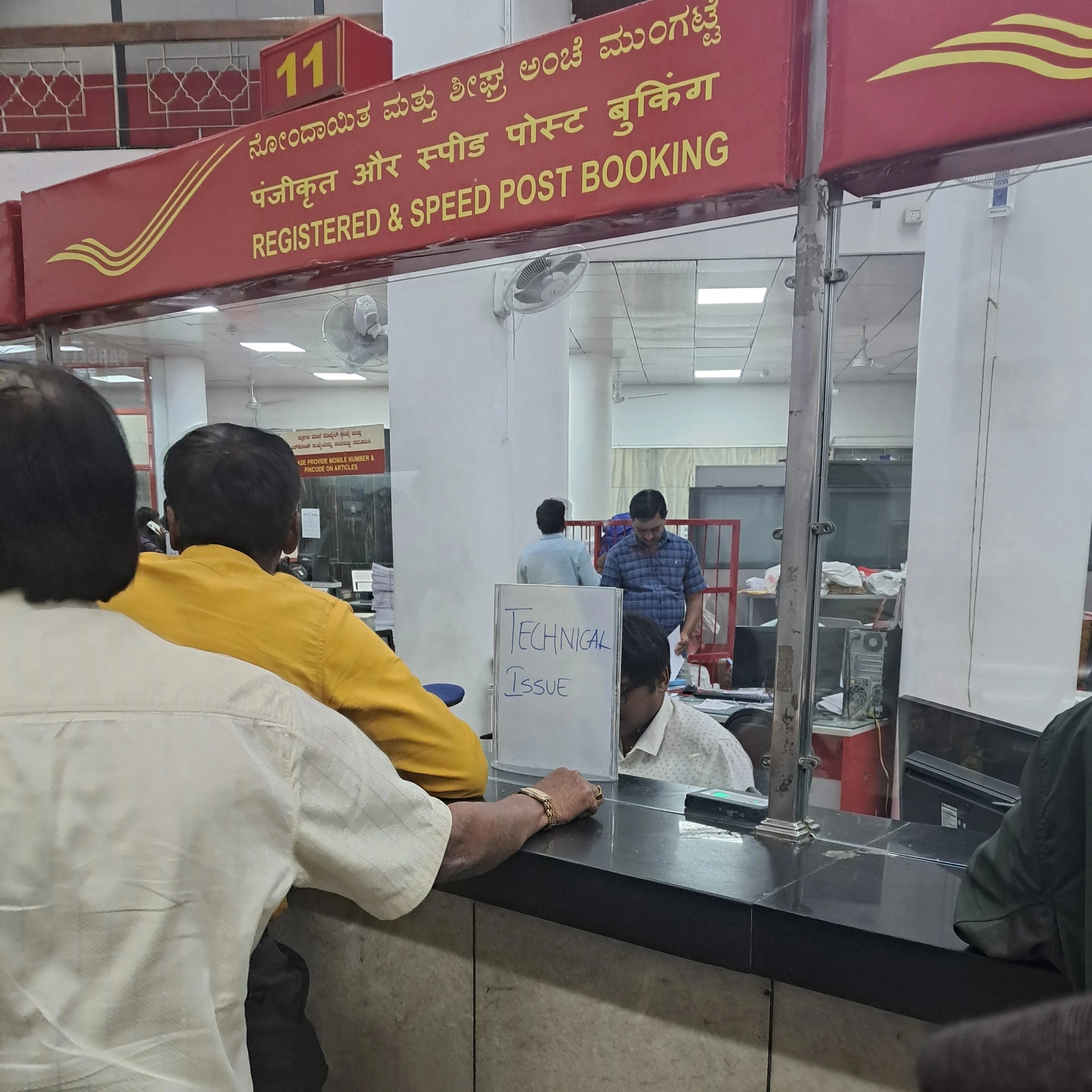
One day, I was even more convinced of POSIWID when I tried sending a postal package to a friend. India Post’s server was down the entire day. I had checked the prices of private services like DHL and Blue Dart online the day before, but on that day, as India Post remained non-functional, the prices of those very services skyrocketed. This wasn’t a one-off—India Post offices had been down consistently over the past few months, predictably so, yet no solution was ever offered. Very ironically, an India Post staff member even advised me that it would be better if I simply went to a private company like DHL or Blue Dart to send my package.
Privatization as the Unseen Benefactor of Public Failure
In countries like India, capital holds power and controls the narrative. Government services, when decent, benefit the collective. But when they falter, opportunities arise for capitalists to hijack the narrative. After all, it’s the capitalists who stand to gain from the government failure.
The logic is quite simple: when public enterprises make money (say, from postal services, railways, or telecom), those earnings are reinvested in infrastructure, schools, transport, universal healthcare. These are public goods—shared, durable, improving equity.
By contrast, private capital funnels profits back into select hands of the stakeholders. Billionaires build sky-villas like Ambani’s Antilia, own fleets of private jets, yachts, luxury cars. The wealth is concentrated; very little trickles down. The system ensures what POSIWID suggests: public failure means private profit.
The State Couldn’t Care Less
An interesting case is that of BSNL – India’s state-owned telecom operator, which was recently found by the Comptroller and Auditor General (CAG) to have failed to bill Reliance Jio for shared passive infrastructure from 2014 to 2024, costing the government ₹1,757 crore (~$200.0 million) + plus interest.
This isn’t mere incompetence. When institutions controlled by the state lapse on enforcing such contracts, they effectively transfer value to powerful private players. Jio, the reliance group owned telecom company – known for its unethical practices to have monopolized the market objectively benefits from this public failure. And when the audit draws attention, BSNL responds by challenging the findings, claiming the loss is overstated (Business Today). Meanwhile, public funds remain uncollected.
Why does this matter? Because it signals that when the public institution fails, capital wins. POSIWID again: it’s not that the system failed by accident; it’s that the failure compensates powerful interests perfectly.
POSIWID as a Call to See the System for What It Is
When systems exhibit consistent failure, especially where the failures benefit the wealthy or entrenched capital groups, it’s not enough to call for efficiency fixes. POSIWID invites something more radical: to question the purpose.
If education systems are chronically underfunded and mismanaged, who benefits? Private schools, ed-tech startups, tutoring conglomerates.
If public healthcare collapses under pressure, who gains? Private hospitals, pharmaceuticals, insurers.
If transportation is unreliable, who profits? Ride-hail apps, logistics moguls, highway toll contractors, and now, even Uber is stepping into the public transit arena. The company recently introduced a “Route Share” feature, basically “Innovating so hard that they re-invented the bus!” and that, too—ONCE AGAIN! This is a service that operates on fixed routes with pickups every 20 minutes, accommodating multiple passengers and costing hefty amount, enough to fill in the pockets of the “Stakeholders” while solving a problem for the commuters that companies like Uber created themselves.
So, we must study the patterns of failure, not just the failures themselves. Because what a system repeatedly does—it might be doing purpose.
Let’s Decode the Hidden Purpose: Dysfunction Is Design, Not Defect
I don’t want to be the person, who just points out a problem, and doesn’t care about the solutions. So, I’d contribute my part in brainstorming by proposing some very preliminary solutions to this problem where the capitalistic entities are draining all our resources and degrading the public facilities to exercise complete control over our lives. So how do we achieve a world where systems serve true public interest?
First of all, since the system is working exactly as it is intended to, we cannot “fix” it. Fixation or improvement assumes that it is somehow failing at its stated purpose. In truth, it is succeeding all too well at serving the interests of those it was designed to serve—the wealthy, the corporations, and the political elites aligned with them. What we need, then, is not an improved or a fixed version of the same machinery, but an entirely new system: one that does not masquerade as public-minded while funneling wealth upward.
This means confronting the uncomfortable reality that voting alone, while symbolically powerful, rarely shifts outcomes in any fundamental way, since it remains part of the very architecture that sustains inequality.
To break from this cycle, we need a radical rethinking of purpose: Public profits must be reinvested in the collective—into healthcare, schools, transport—rather than drained into the luxuries of a few. We must also dismantle the deeply embedded ideology that private control is inherently more efficient, when in fact its efficiency depends on the engineered failure of public services.
And finally, instead of clinging to institutions that consistently betray their promises, we must create new systems defined by their outcomes, not by their rhetoric—systems that measure success by how the underserved live, not by how the powerful thrive. Only then can we move beyond tinkering with dysfunction and begin the harder, but necessary, work of systemic transformation.
We live in a world built on carefully calibrated failure. The kind that maintains inequality, masks public investment, funnels value to capital, while branding itself as benevolence. POSIWID teaches that the real purpose of our systems is in what they do, not what they say.
If we want change, we should stop diagnosing dysfunction. Instead, we should ask: whose interests are served by that dysfunction? And then rebuild systems where the purpose is not private interests but collective good.